Showing posts with label Carnaval. Show all posts

Monday, 27 March 2023

A queen and a sardine

Already audible in the distance is an insistent drumming: diddle-diddle, diddle-diddle - PAM PAM PAM!

In an adjacent street a man is hurrying in the opposite direction from everyone else, looking slightly anxious. Fairly tall, fairly slim, fairly old but still upright, he is trying not to be noticed. This isn't going to work because he is a familiar figure in these streets, easily detected by his white Edwardian sideburns and the Australian-style wide-brimmed hat glued to his head.

Several people are kind enough to warn him he's in the wrong street, the procession is approaching along the broader pedestrian thoroughfare. He assures them he's aware of that but has something else to do first.

This is true but evasive. Finally an English friend passing by, a lady of forthright opinions, unafraid to question the questionable, pauses and demands to know why he's going the wrong way. Caught with no hope of escape, he has to admit it: his urgent mission at the moment is to go the wrong way deliberately. He is trying to get away from La Gran Cabalgata del Carnaval, the carnival cavalcade, highlight of the year for many Gomerans.

Specifically, he's trying to get away from the drums which lead the procession. A Gomeran drum, tambor, is not big - scarcely wider than this strange fellow's hat, in fact - but it can make a man-sized noise in the hands of a young lad. It's mostly boys who do this, boys are genetically programmed to love drums.

At least a dozen of these drums walloped enthusiastically are at this moment creating the diddle-diddle rhythm in concert with a similarly sized group clacking chacaras, the weighty Gomeran version of a flamenco castanet. Interspersed at regular intervals is the PAM PAM PAM of a seriously large drum banged from both sides.

'It hurts my ears,' our hero explains pathetically. Although hard of hearing, he suffers from the strange paradox that he is over-sensitive to loud noise.

'So why,' pursues the forthright friend, 'do you come into town at all when you know there's the carnival procession? Why not just stay at home?'

Fair question. The thing is, the drummers will be followed by a troupe of dancers twirling prettily and then the carriage bearing La Reina del Carnaval, the Carnival Queen. He needs to watch that go by because the daughter of a Gomeran friend has the honour this year of being chosen as - well, not actually the Queen herself, but one of the two Damas de Honor, the Queen's Ladies in Waiting.

From a safe distance he watches the drummers reach the Plaza de Las Americas, the town's main square, still banging away. Finally they stop and begin to disperse into the crowd. He runs back along the street and reaches the plaza just in time to find the Queen's carriage already halted and the Queen being helped down, closely followed by her costume. That needs explaining: the Queen is still decently if skimpily clothed but her costume is a self-supporting, soaring piece of architecture created from feathers, wire, glittery cloth, beads and extraordinary imagination. These things are works of art.

Once safely at ground level the Queen is returned to the middle of her feathers and strapped in for the photographs. Meanwhile, he sees the two Damas still up there on the carriage but preparing to follow their Queen back to earth. They are both ridiculously beautiful and one of them is waving at him. Sara, his friend's daughter! He waves back cheerily, relieved to have arrived in time.

He rejoins his wife at the place where he'd abandoned her and they wander off to see the rest of the procession. Fundamentally it's a series of travelling parties, with most of the carriages recognisable from previous years although redecorated to suit this year's carnival theme. All are noisy and some are very noisy with front-mounted boomboxes, but they're a little less daunting than the drums.

And perhaps not quite as noisy, either, as the Sardine will be in a few days' time.

Carnaval ends (notionally) with a weird event called El Entierro de La Sardina, the Burial of the Sardine. Our sideburned Englishman has attended it many times in the past because it's great fun and also pleasingly irreverent. A mock funeral, it begins with a slow, solemn procession through the streets, led by a small cohort of drummers beating a slow marching pace ahead of a funeral carriage on which lies a sardine the size of Moby Dick. Made of painted paper on a wire frame, it usually boasts scarlet Marilyn Monroe lips and sexy eyelashes.

Accompanying the corpse is an archbishop in fine flowing robes, wielding a chamber pot into which he dips a pastry brush to flick holy water over the watching crowd. He may occasionally fortify himself from a packet of holy cheese-and-onion crisps and a glass of blessed whisky, supplied by his fawning acolytes. Behind and around him are the mourners, hordes of wailing women in slinky black dresses, most of whom are actually young men. Young men are genetically programmed to enjoy shrieking hysterically.

The cortège finally arrives at the beach where the deceased sardine is burned rather than buried despite the event's name. In true Spanish fashion, this sad ceremony is followed by a communal feast of grilled sardines.

Also in true Spanish fashion, although this event definitively marks the end of Carnaval nobody can bear to stop and there will be another procession and dance at the weekend. If I were the Sardine I'd be a bit miffed about that, but of course it doesn't get chance to find out.

-------------- NOTES --------------

Carnaval goes back a long way, being another of the many pagan celebrations cleverly assimilated by Christianity and especially by the Catholic religion, which welcomes any excuse for a party. It's obviously linked - along with the Easter celebration of rebirth - to ancient festivities marking the end of winter and arrival of spring in the northern hemisphere.

In the Christian calendar Carnaval offers a chance to feast and dance shortly before the 40 days of austerity known as Lent, itself a precursor to Easter. The most important day during the celebrations, which typically extend over a week or more, is Shrove Tuesday, the day before Ash Wednesday. In Britain it's better known as Pancake Day and in other countries as Mardi Gras, which is French for 'greasy Tuesday' because - but no, let's not get diverted. In Gomera and Spain as a whole it's martes de Carnaval, Carnival Tuesday, so there's no confusion here about what it's for.

The Entierro de la Sardina symbolises the end of the carnival shenanigans and gluttony, a clear enough metaphor. But why the sardine? Why not a mullet or tuna? A pig, goat or turkey?

As usual there are conflicting theories but the one I find most convincing puts the blame squarely on Carlos III of Spain. He was a big fan of tradition and after coming to the throne in 1759 he insisted the people of Madrid should fast and take things seriously during Lent but, as encouragement, he indulged them in an orgy of eating and drinking in the run-up. He even arranged a splendid fiesta for the final day, at which everyone would feast for free on sardines, a rare luxury in Madrid. Unfortunately by the time the fish had travelled from the coast across mountain, valley and plain to reach Madrid they had all gone rotten, so they buried them and dined on free meat instead.

A story like this was never going to be forgotten quickly and the final feast became an annual event with the sardine as its symbolic martyr. From Madrid it spread to the rest of Spain, the Americas and much of Europe. In Britain we ended up with pancakes and lemon juice.

Tuesday, 10 March 2020

Bring your own powder

It was a tense moment. The two men circled slowly in a Wild West stand-off, weapons poised, each waiting for the other to make a move. Whose nerve would break first?

Suddenly - the oldest trick in the book - Lorenzo glanced sideways with a startled expression. Miguel looked in the same direction and Lorenzo leaped forward, squeezing his weapon as he went. A jet of fine white powder hit Miguel unerringly in the chest.

‘Aagh! Cabrón!’ (you swine!). Miguel set off at a gallop after his opponent who was disappearing into the crowd, hooting with laughter.

We were witnessing the very beginnings of a culture change. A big one, for which you can award much of the credit or blame to Gomera’s close neighbour, the island of La Palma. And Cuba.

Not so long ago the Día de los Polvos, Powder Day, was a minor event of the week-long party known as Carnaval that fills a fiesta vacancy between New Year and Easter. Aimed mainly at the kids, Día de los Polvos was assigned to the quiet Monday before the big procession of carnival floats and dancers on Tuesday. It was basically a licence for young boys (it was always the boys) to unleash their inner hooligan, chasing each other through the streets with big tubes of talcum powder.

Some of them also targeted unwary foreigners, which they were not supposed to do at all. More than once I had to severely warn a threatening urchin ‘Do not attempt to spray me, young man, or there will be grave repercussions,’ then scold him severely when he sprayed me anyway. After the first couple of years we learned to stay at home on the Día de los Polvos.

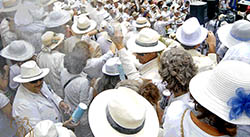
The change came about fairly quickly when a few grown men realised that these young delinquents were having a lot of fun. Fuelling the transformation was the television coverage of the Fiesta de los Indianos in La Palma, which the Palmeros had long ago turned into a major attraction that drew crowds not only from all over La Palma but also from the other Canary Islands and even mainland Spain. As in the rest of the Carnaval celebrations this is a day for letting loose, for unlimited fun and loud music, but the chief characteristic is that everybody wears white clothing and pours talcum over everybody else. The music is always Cuban, which is almost impossible to resist dancing to, or jiggling or at the very least twitching, and the air rapidly becomes a swirling fog filled with wild white figures gyrating inside it.

For me the images transmitted by those brave television crews are a stark warning to keep well away from the madness, but other people find it strangely compelling. No doubt under pressure from these more party-minded citizens, the town council here in San Sebastián decided a few years ago to add a little something to our own very low-key event. They organised a dance in the evening for adults, clearly labelled as a special dance for Día de los Polvos. A salsa dance band would play in the main pedestrian street, cafes and bars would be open until late and kioscos would stay open all night.

Guidelines were issued on how one should dress for this occasion, although everyone knew already from observing the Palmeros. White clothing is obligatory as well as practical, given that any other colour will soon turn white anyway, but you are also supposed to present an old-world appearance, vaguely 1800s, with the men parading in smart white suits and a panama hat while the ladies swish beside them in long white dresses. Optional accessories are a white sun-umbrella for the women and a small leather suitcase for the men. Oh, and a big cigar, and a bottle of rum. And bring your own talcum powder.

It was an instant success. Locals prepared for it with typical enthusiasm, turning up in their hundreds to fill the town with music, laughter and a sweet-smelling fog. Amazingly, it has now become one of the most popular features of Carnaval, with two Cuban music groups playing in the evening followed by an all-night dance with two full dance bands.

On the morning after the revelries of Día de los Polvos the pedestrian streets, lamp-posts and shop windows have mostly turned white like the revellers, but the council sends in a clean-up team and a neat little electric vehicle armed with a high-pressure hose to wash it all away.

Ironically, this year the event followed immediately after the heaviest calima we’d had for at least thirty years. Calima is extremely fine dust from the Sahara desert which hangs in the air like a dry fog. Usually it’s more misty than foggy but this time it was denser than a Delhi smog and turned cars and streets a dull pink, so what with that and the talcum powder the town ended up looking like grandma’s bedroom after the kids had run amok with her make-up. Smelled nice though.


--------------- NOTES ---------------
So what’s it all about? Why the talcum powder, why the old-fashioned clothes? The clue is in the La Palma name for the event, the Fiesta de los Indianos. Its origins go back to the 19th century when Palmeros who had emigrated to the Indies - that’s the West Indies, and especially Cuba - returned home considerably richer than they’d left, dressed like gentlefolk instead of peasants, smoking big Havana cigars, drinking Cuban rum and even trailing creole servants to carry their luggage in leather suitcases. They were aping the European colonials who had occupied Latin America. Perhaps a little too showy, perhaps a little boastful of their new wealth, perhaps deserving the gentle mockery they received in the annual fiesta. The event was incorporated into Carnaval somewhat later, in the early 1900s.

The white powder is a bit of a mystery but among the various explanations I’ve read, the most likely is that in Cuba in those early days some blacks and dark-skinned creoles practised rituals that involved whitening the skin. Whatever they used it wouldn’t have been talcum, which is a modern convenience. And one for which I’m sure the local sell-everything Chinese bazaar is deeply grateful. In the weeks leading up to Carnaval they stock up with pallet-loads of the stuff, hundreds of giant tubes, all of which get sprayed into oblivion in the course of a few hours. Beats the heck out of selling it in tiny dispensers for the comfort of baby’s bottoms.