Showing posts with label covid-19. Show all posts

Tuesday, 26 May 2020

Side effects of the virus

There is a certain spot in town where you can sip coffee while watching little whirlwinds play games with fallen leaves and paper serviettes. It’s a result of the prevailing northerly winds blowing air past a tall building and creating vortices.

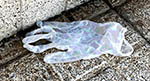
Today an especially powerful vortex had captured two flimsy plastic gloves and was whisking them at speed past my nose then under my feet, time and again. I succeeded in catching them only when both got snagged by a low bush.

Plastic gloves are one of many unforeseen side effects of the new coronavirus, Covid-19.

Plastic gloves
Lightweight, transparent and single-use, these things are now issued at the entrance of every supermarket and you must wear them, along with your face mask. Some shops have already run out of plastic gloves and give you a plastic bag bearing a stencilled drawing of a hand. Whoever thought this was a good idea should try opening a plastic bag to put their tomatoes in while wearing a plastic bag on each hand.

Worse, these gloves and bags regularly escape into the wider world. Treacherous little devils, they jump from supermarket disposal bins, slip from people’s grasp as they take them off, fly from municipal litter bins or simply wait to be thrown to the pavement. They’re an entirely new form of environmental pollution.

Beards
How the virus has achieved this I can’t imagine, but the fact is that male chins of all ages are breaking into blossom. They range from timid two-day stubble to full-blown, rebellious foliage. At a rough estimate the number of beards and moustaches walking around town has at least doubled, perhaps quadrupled.

Closely related to this effect is its exact opposite in which the upper skull is shaved down to a blue-tinted, shiny dome with intriguing knobbles at the back. This is easier to explain: when you’re faced with trimming your own hair because all hairdressers are in lockdown, shaving it all off is the most reliable technique.

Queues
Spanish culture tends to view queuing as a freewheeling concept that relies on knowing who arrived just before you did. You ask the most likely person if they are el ultimo (gentleman) or la ultima (lady). That has become far more challenging now that everyone is required to distance themselves from everyone else by at least two metres. Queues can snake backwards along the street towards the shimmering horizon. In more constricted spaces such as the covered market they disintegrate into random placements intermingled with all the others who are just hanging about, waiting for their wife, waiting for a table at the café, passing an hour or two in the (distant) company of others.

And what does two metres of distancing look like in the real world? Nobody’s very sure. Children were briefly seen waving long-handled brooms to poke the person in front, a rough measure, but parents seem to have decided this has too much fun potential and I haven’t seen any brooms lately.

Humiliation
The law dictates that café tables must be disinfected between every set of clients. This is fine and reassuring until it’s your turn to leave, when you look behind and see the waiter spraying your table and chairs to eliminate your personal contamination. Now we know how dogs feel when their owner stoops with a plastic bag to clean their deposits from the pavement.

Microsoft Windows
Suddenly it’s not giving trouble any more! Nobody calls you at home from Microsoft Support to tell you they’ve detected a problem with your computer, even if you’re not using Microsoft at all but Apple! The virus has convinced all those dedicated support teams in India that their welfare is more important than yours. If your computer is on the point of cracking up yet again, you’ll just have to sort it out for yourself.

Flu and colds
There aren’t any. We’re all so clinically sanitised, distanced, untouched and untouching that the bugs have nowhere to go.

Smoked herring
There isn’t any. We personally depend on smoked herring - kippers - for our government-recommended weekly dose of oily fish, but try finding it on Amazon these days. The world stock of canned kippers is now stacked on the shelves of private kitchens, emergency rations for when the virus wins and people have to barricade themselves into their houses against the wild-eyed hordes outside.

And many more…
Once you start to think about it there are endless side effects of this novel situation. One of them is plain old boredom, which means people have been desperately looking for new ways to occupy the kids or themselves. Like, for example, writing lists of unforeseen side effects of the virus.

-------------- NOW AVAILABLE - THE PAPERBACK --------------

Amazon sells an attractive paperback book containing 50 stories from this blog, edited and with new illustrations. An ideal present for anyone who knows La Gomera, or would like to know it!

Search for Do they still whistle? on amazon.co.uk or amazon.es or any other Amazon website worldwide.

Wednesday, 8 April 2020

Fear and dread


Like one that on a lonesome road
Doth walk in fear and dread
[…]
Because he knows a frightful fiend
Doth close behind him tread.


The scene: a pedestrian street in San Sebastián, where I’m standing outside the entrance to a small supermarket. An elderly lady hampered by two large shopping bags is trying to squeeze past a delivery trolley full of boxes, in order to get out. I wait patiently in the street while a small dog with its lead hooked around a bollard strains to get at my feet.

As this impasse was beginning to resolve itself a new element arrived in the form of an astronaut in a white all-in-one suit that covered not only his body but the whole of his head as well, leaving only a small aperture for his face. Most of that was covered by wrap-around goggles and a bulging white mask over his nose and mouth. He wore a yellow cylinder on his back and was waving a long wand from which he sprayed something that looked worth avoiding.

Pausing for a moment, he caught sight of me hovering nervously a metre or two away and greeted me cheerily: ‘Aha, hola amigo! Com’estas!’ How are you?

‘Fine, fine,’ I answered. ‘But who...’ All I could see was a pair of eyebrows.

He roared with laughter, causing his face mask to wobble. He pulled it down, revealing the smiling face of a regular associate from the distant days when we all used to sit around café tables in the sunshine. Sipping our coffee or wine or beer, welcoming each new arrival, exchanging occasional comments about the weather or the politicians. An amorphous group of people enjoying each others’ casual company.

I was pleased to see the astronaut, a reminder of how things used to be, but we couldn’t stop and chat this morning. He pulled up his mask, finished spraying around the supermarket door and the pavement outside then headed off to the next one, leaving a pleasant flowery scent of disinfectant.

He was one of a small team recruited by the town council to help protect us from The Virus. The island council, too, has recruited a team of sprayers, an entire army of them, each equipped with a smart astronaut outfit in bright sky blue.

The other weapon in this battle against the unseen enemy is, of course, social distancing, of which the most important element is personal isolation. The Spanish government led by Pedro Sánchez decided at a fairly early stage that isolation meant not leaving home. No wiffly-waffly guidelines, a clear and simple instruction to stay indoors. Tough but realistic. An infringement could cost you anything from 300 to 30,000 euros. (I’m not sure what you’d have to do to merit the big one but it would certainly ensure your place in local history.)

We’re allowed out for truly essential trips but under close monitoring. Cycling into town the other day I was stopped by a policeman stationed at a zebra crossing. I have the greatest respect for the police on this island and they’re a nice bunch of people, but this one was wearing a green surgical face mask that made him look sinister. ‘Adonde va?’ he demanded, where was I going?

To the post office to send a parcel, I told him, and then to the mercadillo, the market, to buy fruit and vegetables. I was prepared to expand on this - we’re both vegetarians, we need fresh fruit and vegetables, it’s what we eat. And - I could have continued if necessary - we believe the quality and choice you find in the market stalls is better than that of the supermarkets, and... but he waved me on my way, food is allowed, you can go out to buy food without penalty. Up to a point. I’ve seen one unfortunate guy having his name taken for carrying a single red pepper in a plastic carrier bag, a token purchase.

Which brings me to the most striking aspect of this alien situation in which we find ourselves. It was clear from my mental preparations for meeting a policeman that I felt guilty about being out at all. Why should I feel guilty about shopping for food? But I do. So does everyone else. In the market people shuffle around with their heads down, many wearing bulging white masks like the astronaut, some in pale green surgical masks like the policeman (where do they get those from?), others with scarves pulled across their face. In this most sociable of public spaces where traditionally everyone stops for a few words or a hearty gossip, we all sidle past each other as though trying not to be seen.

There’s a strong element of fear, of course. The next person you talk to might be emitting viruses, blown by a waft of air towards your nose. But it’s highly unlikely. The virus has scarcely touched this little island. We’ve had just seven confirmed cases, mostly involving visitors from elsewhere, all of whom were successfully quarantined and quickly recovered. Why are we all so anxious? It seems that fears, doubts and imaginings are even more contagious than covid-19.


---------------------- NOTES ----------------------
The quotation is from The Rime of the Ancient Mariner by Samuel Taylor Coleridge.

But did you know that this malignant coronavirus currently threatening the entire human species and many others is just 125 nanometres across? A nanometre is one-millionth of a millimetre. They’re invisible specks, ridiculously small - you could fit about 10,000 of them side by side on the head of a pin. They might be there already.

So, can a face mask really catch something so tiny? As usual in cases like this, my online investigations suggests that nobody really knows for sure, but anyway I wouldn’t want to rely on it.

If you’re wearing a mask and you cough or sneeze, your mask might catch any moisture flying from your mouth, tiny droplets on which the virus could hitch a lift if you’re already infected - so you’re doing other people a favour. This is good and laudable but doesn’t help you personally.

If on the other hand another infected individual sneezes and your face mask catches some droplets they’ve emitted, you then have a few million viruses on the front of your mask. When you next touch the mask you will get the viruses on your fingers, and if you subsequently touch your eyes, mouth or nostrils the job’s done, you’ve infected yourself.

The only really appealing thing about face masks is that you can make them out of old tee shirts, which would be one way to reduce the pile of old tee shirts in my cupboard.