Wednesday, 8 April 2020

Fear and dread


Like one that on a lonesome road
Doth walk in fear and dread
[…]
Because he knows a frightful fiend
Doth close behind him tread.


The scene: a pedestrian street in San Sebastián, where I’m standing outside the entrance to a small supermarket. An elderly lady hampered by two large shopping bags is trying to squeeze past a delivery trolley full of boxes, in order to get out. I wait patiently in the street while a small dog with its lead hooked around a bollard strains to get at my feet.

As this impasse was beginning to resolve itself a new element arrived in the form of an astronaut in a white all-in-one suit that covered not only his body but the whole of his head as well, leaving only a small aperture for his face. Most of that was covered by wrap-around goggles and a bulging white mask over his nose and mouth. He wore a yellow cylinder on his back and was waving a long wand from which he sprayed something that looked worth avoiding.

Pausing for a moment, he caught sight of me hovering nervously a metre or two away and greeted me cheerily: ‘Aha, hola amigo! Com’estas!’ How are you?

‘Fine, fine,’ I answered. ‘But who...’ All I could see was a pair of eyebrows.

He roared with laughter, causing his face mask to wobble. He pulled it down, revealing the smiling face of a regular associate from the distant days when we all used to sit around café tables in the sunshine. Sipping our coffee or wine or beer, welcoming each new arrival, exchanging occasional comments about the weather or the politicians. An amorphous group of people enjoying each others’ casual company.

I was pleased to see the astronaut, a reminder of how things used to be, but we couldn’t stop and chat this morning. He pulled up his mask, finished spraying around the supermarket door and the pavement outside then headed off to the next one, leaving a pleasant flowery scent of disinfectant.

He was one of a small team recruited by the town council to help protect us from The Virus. The island council, too, has recruited a team of sprayers, an entire army of them, each equipped with a smart astronaut outfit in bright sky blue.

The other weapon in this battle against the unseen enemy is, of course, social distancing, of which the most important element is personal isolation. The Spanish government led by Pedro Sánchez decided at a fairly early stage that isolation meant not leaving home. No wiffly-waffly guidelines, a clear and simple instruction to stay indoors. Tough but realistic. An infringement could cost you anything from 300 to 30,000 euros. (I’m not sure what you’d have to do to merit the big one but it would certainly ensure your place in local history.)

We’re allowed out for truly essential trips but under close monitoring. Cycling into town the other day I was stopped by a policeman stationed at a zebra crossing. I have the greatest respect for the police on this island and they’re a nice bunch of people, but this one was wearing a green surgical face mask that made him look sinister. ‘Adonde va?’ he demanded, where was I going?

To the post office to send a parcel, I told him, and then to the mercadillo, the market, to buy fruit and vegetables. I was prepared to expand on this - we’re both vegetarians, we need fresh fruit and vegetables, it’s what we eat. And - I could have continued if necessary - we believe the quality and choice you find in the market stalls is better than that of the supermarkets, and... but he waved me on my way, food is allowed, you can go out to buy food without penalty. Up to a point. I’ve seen one unfortunate guy having his name taken for carrying a single red pepper in a plastic carrier bag, a token purchase.

Which brings me to the most striking aspect of this alien situation in which we find ourselves. It was clear from my mental preparations for meeting a policeman that I felt guilty about being out at all. Why should I feel guilty about shopping for food? But I do. So does everyone else. In the market people shuffle around with their heads down, many wearing bulging white masks like the astronaut, some in pale green surgical masks like the policeman (where do they get those from?), others with scarves pulled across their face. In this most sociable of public spaces where traditionally everyone stops for a few words or a hearty gossip, we all sidle past each other as though trying not to be seen.

There’s a strong element of fear, of course. The next person you talk to might be emitting viruses, blown by a waft of air towards your nose. But it’s highly unlikely. The virus has scarcely touched this little island. We’ve had just seven confirmed cases, mostly involving visitors from elsewhere, all of whom were successfully quarantined and quickly recovered. Why are we all so anxious? It seems that fears, doubts and imaginings are even more contagious than covid-19.


---------------------- NOTES ----------------------
The quotation is from The Rime of the Ancient Mariner by Samuel Taylor Coleridge.

But did you know that this malignant coronavirus currently threatening the entire human species and many others is just 125 nanometres across? A nanometre is one-millionth of a millimetre. They’re invisible specks, ridiculously small - you could fit about 10,000 of them side by side on the head of a pin. They might be there already.

So, can a face mask really catch something so tiny? As usual in cases like this, my online investigations suggests that nobody really knows for sure, but anyway I wouldn’t want to rely on it.

If you’re wearing a mask and you cough or sneeze, your mask might catch any moisture flying from your mouth, tiny droplets on which the virus could hitch a lift if you’re already infected - so you’re doing other people a favour. This is good and laudable but doesn’t help you personally.

If on the other hand another infected individual sneezes and your face mask catches some droplets they’ve emitted, you then have a few million viruses on the front of your mask. When you next touch the mask you will get the viruses on your fingers, and if you subsequently touch your eyes, mouth or nostrils the job’s done, you’ve infected yourself.

The only really appealing thing about face masks is that you can make them out of old tee shirts, which would be one way to reduce the pile of old tee shirts in my cupboard.

Sunday, 29 March 2020

Call in the police!

I first posted this story in August 2019 but quickly removed it for reasons I’ll explain later.

This problem has been ignored for too long. Nobody’s doing anything about it. And as it affects me directly, I’ve made the decision to do something myself. But what to do, that’s the question.

After a little thought the answer is obvious. We must go to the police! Explain the situation. That’s what the police are for, to sort out citizens’ problems. First we must decide which police, though. There are several varieties of police in Spain but here in La Gomera our choice comes down to two: the Guardia Civil or the Policía Local.

Maybe not the Guardia, a national force that regularly publicises its success in seizing million-euro consignments of crack cocaine or catching international criminals with false moustaches in Marbella. The Policía Local seems more the right level for our kind of complaint.

I have already prepared a one-page report on the problem, complete with photograph and explanatory text in faultless Spanish. Well, it looks faultless to me. This should save too much nervous babbling and hand-waving when face to face with a police officer.

Choosing our time carefully - not too early in the morning, but safely before desayuno (breakfast) at around 10:30 when everyone goes out for a coffee and sandwich, including most of the police - we head towards what passes for the local police station.

One of the clearest indications that this town is not a hotbed of petty crime is that there isn’t really a police station. The Policía Local have a small office in a multi-purpose building which they share with, among other organisations, the local land registry. It’s on the outskirts of town and not easy to find unless you know where to look. Their sign includes a rather nice modern logo that reminds me of Dr Who’s Tardis, an old-time police telephone box.

Passing through the modest entrance portal into a surprisingly long corridor, we walk past a branch to the right which leads to the land registry then straight on to a small doorway down at the far end. A small sign to the left of the door announces Policía Local: Atención al Ciudadano, Attention to the Citizen, which is encouraging. The door is open, revealing a small office with a large desk but nobody behind it. I knock politely on the door - always best to show respect - and from an inner office emerges a youngish police officer (they’re all youngish when you’re my age), at first cautiously then with a nice smile. ‘Sí?

We have a small problem, we explain. Nothing serious, but it needs looking at. He ushers us into his inner office and indicates two chairs in front of his desk.

I begin by explaining that we cycle every day into town and often call into the covered market, where we park our bikes in the pedestrian street outside. ‘Vale,’ right, nods the policeman. Clear enough so far. There’s a bike rack, I tell him, where we leave our bikes, and in this bike rack is an abandoned bicycle. It’s got two flat tyres and it has been there for several months. This wouldn’t matter so much except that the bike is right in the middle of the rack where it really gets in the way.

I hand him my written account and point to the photo, then watch a little nervously as he peruses the report - is this too trivial, am I wasting police time? - but he nods thoughtfully. ‘It’s locked to the rack?’

‘It is. Cable and lock.’

‘It would be less of a nuisance if it were at one end,’ he comments. Yes, exactly!

A colleague wanders in to see what’s going on, nods cheerfully at us - we’ve known him for a long time - and takes a look at the photo. ‘This tree’s in the way as well,’ he points out. ‘It’s not a good place for a tree.’

‘It isn’t,’ agrees the first policemen. He straightens up, looking perkier. He’s beginning to see his way to a solution. It might be best, he observes thoughtfully, to get the Ayuntamiento, the town council, to move the rack to somewhere more sensible, away from the tree. And get rid of the bike at the same time.

Well, yes, but...

‘Leave it with me,’ he says. ‘Can I take a copy of this report?’

‘Keep it, keep it,’ I offer generously. ‘It’s for you.’

Nothing more we can do. Handshakes all round, thanks for your time etc, then the first policeman escorts us to the door. We leave feeling we’ve done our citizens’ duty but fairly sure the abandoned bike will still be there several months later. My report is going to be passed to the Ayuntamiento along with a recommendation that they move the entire bike rack to a different location. This will take time.

Two weeks later…
Parking my bike as usual in the rack, it took me a moment to realise that something had changed. Tree still there, rack still there - but the abandoned bike had gone. Six clear slots to choose from.

How wrong I was to doubt! Of course the police would take action! And commendably quickly too - I’m sure there were a few forms to fill in, stamp, copy and file before they could send someone along with bolt cutters to sever the cable. I would like to record here my sincere thanks to the Policía Local not only for removing the bike but also for demonstrating that in a free and open society, the citizen’s voice is heard.

Postscript
Why did I delete this story after its first posting? Because the bike reappeared, that’s why. Just a few days after it had gone. Complete with cable and lock, and in the same place in the middle of the bike rack. I assumed the owner had noticed its disappearance and demanded its return. Best to keep my head down for a while.
However, a week or so later it vanished again and this time it didn’t come back. My best guess is that at the first try someone had neglected to follow the proper administrative procedures for removing bicycles from bike racks, and was obliged by somebody else to put it back before doing so.

---------------------- NOTES ----------------------
The Policía Local wear blue uniforms and drive blue-and-white cars. They can look a bit intimidating because of the various armaments slung from their trouser belts but in all other respects they are very friendly and approachable. Mostly they concern themselves with local matters such as traffic control during fiestas or the daily chaos of the school run.

Also somewhat fearsome in appearance but generally just as friendly are the Guardia Civil, who wear green uniforms and drive military-green vehicles. They are concerned mostly with the heavier issues such as robbery, violence, drugs and traffic accidents so on this island it’s a fairly light workload, but they do cruise around in their vehicles to keep an eye on things. In contrast to the Policía Local they occupy a splendid, fortress-like building on a hill overlooking the town.

The Guardia was once an important tool of subjugation for the Generalísimo, Francisco Franco, and today’s Guardia still has the official motto Todo por la patria – all for the mother country. However, the Guardia themselves are now far removed from that dark history, a well-respected body of men and women, the kind Granny would be delighted to see her grandchild sign on for while other grannies’ offspring roam the world in bare feet.

Tuesday, 10 March 2020

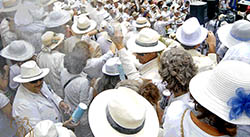
Bring your own powder

It was a tense moment. The two men circled slowly in a Wild West stand-off, weapons poised, each waiting for the other to make a move. Whose nerve would break first?

Suddenly - the oldest trick in the book - Lorenzo glanced sideways with a startled expression. Miguel looked in the same direction and Lorenzo leaped forward, squeezing his weapon as he went. A jet of fine white powder hit Miguel unerringly in the chest.

‘Aagh! Cabrón!’ (you swine!). Miguel set off at a gallop after his opponent who was disappearing into the crowd, hooting with laughter.

We were witnessing the very beginnings of a culture change. A big one, for which you can award much of the credit or blame to Gomera’s close neighbour, the island of La Palma. And Cuba.

Not so long ago the Día de los Polvos, Powder Day, was a minor event of the week-long party known as Carnaval that fills a fiesta vacancy between New Year and Easter. Aimed mainly at the kids, Día de los Polvos was assigned to the quiet Monday before the big procession of carnival floats and dancers on Tuesday. It was basically a licence for young boys (it was always the boys) to unleash their inner hooligan, chasing each other through the streets with big tubes of talcum powder.

Some of them also targeted unwary foreigners, which they were not supposed to do at all. More than once I had to severely warn a threatening urchin ‘Do not attempt to spray me, young man, or there will be grave repercussions,’ then scold him severely when he sprayed me anyway. After the first couple of years we learned to stay at home on the Día de los Polvos.

The change came about fairly quickly when a few grown men realised that these young delinquents were having a lot of fun. Fuelling the transformation was the television coverage of the Fiesta de los Indianos in La Palma, which the Palmeros had long ago turned into a major attraction that drew crowds not only from all over La Palma but also from the other Canary Islands and even mainland Spain. As in the rest of the Carnaval celebrations this is a day for letting loose, for unlimited fun and loud music, but the chief characteristic is that everybody wears white clothing and pours talcum over everybody else. The music is always Cuban, which is almost impossible to resist dancing to, or jiggling or at the very least twitching, and the air rapidly becomes a swirling fog filled with wild white figures gyrating inside it.

For me the images transmitted by those brave television crews are a stark warning to keep well away from the madness, but other people find it strangely compelling. No doubt under pressure from these more party-minded citizens, the town council here in San Sebastián decided a few years ago to add a little something to our own very low-key event. They organised a dance in the evening for adults, clearly labelled as a special dance for Día de los Polvos. A salsa dance band would play in the main pedestrian street, cafes and bars would be open until late and kioscos would stay open all night.

Guidelines were issued on how one should dress for this occasion, although everyone knew already from observing the Palmeros. White clothing is obligatory as well as practical, given that any other colour will soon turn white anyway, but you are also supposed to present an old-world appearance, vaguely 1800s, with the men parading in smart white suits and a panama hat while the ladies swish beside them in long white dresses. Optional accessories are a white sun-umbrella for the women and a small leather suitcase for the men. Oh, and a big cigar, and a bottle of rum. And bring your own talcum powder.

It was an instant success. Locals prepared for it with typical enthusiasm, turning up in their hundreds to fill the town with music, laughter and a sweet-smelling fog. Amazingly, it has now become one of the most popular features of Carnaval, with two Cuban music groups playing in the evening followed by an all-night dance with two full dance bands.

On the morning after the revelries of Día de los Polvos the pedestrian streets, lamp-posts and shop windows have mostly turned white like the revellers, but the council sends in a clean-up team and a neat little electric vehicle armed with a high-pressure hose to wash it all away.

Ironically, this year the event followed immediately after the heaviest calima we’d had for at least thirty years. Calima is extremely fine dust from the Sahara desert which hangs in the air like a dry fog. Usually it’s more misty than foggy but this time it was denser than a Delhi smog and turned cars and streets a dull pink, so what with that and the talcum powder the town ended up looking like grandma’s bedroom after the kids had run amok with her make-up. Smelled nice though.


--------------- NOTES ---------------
So what’s it all about? Why the talcum powder, why the old-fashioned clothes? The clue is in the La Palma name for the event, the Fiesta de los Indianos. Its origins go back to the 19th century when Palmeros who had emigrated to the Indies - that’s the West Indies, and especially Cuba - returned home considerably richer than they’d left, dressed like gentlefolk instead of peasants, smoking big Havana cigars, drinking Cuban rum and even trailing creole servants to carry their luggage in leather suitcases. They were aping the European colonials who had occupied Latin America. Perhaps a little too showy, perhaps a little boastful of their new wealth, perhaps deserving the gentle mockery they received in the annual fiesta. The event was incorporated into Carnaval somewhat later, in the early 1900s.

The white powder is a bit of a mystery but among the various explanations I’ve read, the most likely is that in Cuba in those early days some blacks and dark-skinned creoles practised rituals that involved whitening the skin. Whatever they used it wouldn’t have been talcum, which is a modern convenience. And one for which I’m sure the local sell-everything Chinese bazaar is deeply grateful. In the weeks leading up to Carnaval they stock up with pallet-loads of the stuff, hundreds of giant tubes, all of which get sprayed into oblivion in the course of a few hours. Beats the heck out of selling it in tiny dispensers for the comfort of baby’s bottoms.

Wednesday, 18 December 2019

Wheels

Ah, what it is to be young!

Agony and uncertainty, a lot of the time. For example, the other day we watched a young boy trying to impress a member of the opposite sex. He was a local lad while she was a visiting foreigner, a German, seated outside a café with the rest of the family. He began by pausing briefly near her table on his motorbike. She ignored him, so he then tried zooming past at speed. At his first pass she looked up with a flicker of interest, so he skidded around and zoomed back the other way. At the third pass she smiled and tentatively waved a hand. He was doing well!

After a few minutes of this, with things progressing nicely, the girl’s family decided enough was enough and grandad took her off for a walk around the plaza. She was around three years old, her suitor something similar, and his motorbike was one of those plastic things you sit astride while crouching low in the proper motormaniac way. He had to propel it with his feet but could do a convincing turn of speed and authentic skid-turns on his wide plastic tyres.

But now he had to watch as his potential conquest disappeared, although she did look back a little wistfully as she went. He was left there with nothing to do, feeling a bit silly. He dismounted from his motorbike, flipped it upside down and banged the underneath of it with his fist.

‘Problems with the engine?’ I suggested.

‘No.’ He banged it again just to be sure, flipped it the right way up and zoomed off somewhere else, confidence renewed.

If only it were always that easy. Soon he’ll have a real bike and more complex relationships to deal with. Perhaps his next step in that direction will be a patinete, the old-fashioned foot-propelled scooter that has staged a revival in recent years. Most of the local kids have one, sometimes the modern three-wheeled variant where you perch on a V-shaped frame and waggle your legs from side to side to keep it moving. A skilled rider can go almost as fast as the three-year old on his motorbike. Terrific exercise for kids, but I doubt if I could manage more than a couple of waggles before putting my back out.

Not so good healthwise are the two-wheeled, self-balancing hoverboards you stand on to be effortlessly transported by electric traction. These landed on San Sebastián’s main plaza a couple of years ago as catastrophically as a Dalek invasion, the first big wave being on the sixth of January after the annual visit by the Three Kings who do the job of Father Christmas here. Fortunately the invaders seem to have succumbed to some fatal disease - always a risk for aliens (see The war of the worlds by HG Wells) - because there are very few of them still around.

Or perhaps it’s not so fortunate because they seem to be reincarnated as electric scooters. This is potentially an even more serious threat because they appeal to adults at least as much as children. On my cycle route home I’m now regularly overtaken by an e-scooter whooshing silently by, its rider poised as upright and elegant as an emperor on a chariot.

They’re surprisingly capable, these things. One of the cruise ships that calls into San Sebastián offers its passengers guided tours into the hills on electric bicycles, but another has recently started doing the same thing with electric scooters. They set off from the port in a long line, all wearing helmets but otherwise a motley collection of riders from teenagers to old men with beards. Hands grasping their narrow handlebars, they glide silently through the streets in military convoy and out into the hills like some weird beings from an old surrealist movie or an early Doctor Who.

An admission: I’d quite like an e-scooter.

I don’t need it and couldn’t justify it but they do look like fun. Although not, I would think, something to go for if you’re trying to impress the girls because any skid-turn or other masterly flourish is likely to send rider and scooter spinning in opposite directions. Perhaps I won’t bother.


NOTES
for the serious student
We’ve seen an increasing variety of e-transport in San Sebastián in recent years including adult versions of the two-wheeled hoverboard and even the futuristic single-wheeled e-wheel. It’s just a wheel.

But it’s the electric scooters that have really blossomed - and with them, the number of complaints from pedestrians. The Ayuntamiento, the town council, recently issued a reminder about correct behaviour. You mustn’t go faster than 10 kilometres an hour (about 6mph) on a pavement and you must keep at least 1 metre away from pedestrians or the facades of buildings. You must not perform any manoeuvre that might put pedestrians at risk (such as, I suppose, attempting skid-turns, jump-turns or wheelies). If in doubt, the correct way to get around with an e-scooter is to carry it. Umm… doesn’t that rather… well, okay. Pedestrian safety comes first.

These excellent guidelines are likely to prove only temporary because in mainland Spain there have been a lot of accidents involving e-scooters - some 300 in 2018 - and new regulations will soon come into force throughout the country, including here. You will no longer be able to ride your e-scooter at all on a public pavement. All such ‘personal mobility’ devices will be considered vehicles, just like cars and motorbikes. On roads the maximum speed will be 25 kilometres an hour and you could be fined if caught riding while using a mobile phone.

This all sounds very sensible and reasonable. Rather more so than the British approach which currently bans you from riding your e-scooter on public roads as well as pavements, limiting you to pootling around on your private airfield or country estate.

Friday, 18 October 2019

The impossible romance

Young, lovely and a little daft and dreamy like so many girls of her age, she gazed wistfully at the big island just across the water. The high peak that soared skywards through the clouds, strangely white at the top and especially in winter, turned to flaming gold when lit by the setting sun. There were stories of it spitting fire and smoke in the past and, although she had never seen that, she had seen faint lights lower down, small fires burning nearer the coast, so she knew there were people living there.

Were they like her own folk, the guanches, or different altogether? Perhaps more handsome. Especially the young men. She fantasised that among them was a prince who would somehow find his way across the water, take her into his arms and sweep her into a glorious future. Who would save her from the imminent marriage her father - the local chieftain - had arranged, to the son of a tribal chieftain from another canton. A prince if you like but small, ugly and terribly boring.

Meanwhile, over on the Island of the White Peak, the youngest son of the mencey or ruler of the Adeje canton watched the dazzling sunset outlining the low, dark shape of the Mysterious Island and felt that it was trying to tell him something. He was stifled by his life at home, keen for adventure and, like so many boys of his age, stupid enough to do almost anything. He fantasised about swimming across to that intriguing island... but a shred of sanity warned him he’d never make it.

Everything changed during the autumn Beñesmen celebrations, the most important fiestas of the year, celebrating the annual harvest. Music, dancing, games, wine and copious quantities of food. It was the roasting of the goats that gave him the idea. Rescuing a discarded bladder from one of the slaughtered animals, he cleaned it, tied it at one end, inflated it then tied a knot at the open end to contain the air.

He’d learned this trick as a kid! Why hadn’t he thought of it before? Preparing two more bladders to be quite sure, he crept away unnoticed from the evening’s celebrations, tied the bladders around his chest, waded into the sea and set off with purposeful strokes towards the island.

The next morning the young princess spotted a figure sprawled on the beach as though washed up by the sea. She ran down to investigate, turned the body over and saw that it was a young man, and still alive. Pulling off three limp bladders and some seaweed dangling from his chest she patted his cheeks gently to try and revive him.

His eyes opened, and they were beautiful eyes. He smiled a little, and it was a beautiful smile. They fell instantly in love with each other.

At first the girl’s family were impressed by the young newcomer’s feat in crossing the water and treated him with respect, gave him food and shelter to restore his strength. He spoke their language, although a bit strangely, and everything was fine for a few days until the princess announced that she was cancelling her previously arranged engagement and would be marrying this new man instead. Seeing their darkening expressions she argued tearfully ‘He’s a prince! And I love him!’

An urgent council of elders from the two families involved rapidly agreed that breaking her engagement and marrying a foreigner was way out of line, that the young man had clearly abused the hospitality of his hosts and that he would have to go, one way or another. Find him at once, bring him here and we’ll pass sentence!

Nobody knew where he was that morning but there were suspicions. He and the princess had gone into hiding. She was well in tune with local customs and had quickly realised they were both in deep trouble.

‘What’s that whistling? What are they saying?’ whispered the prince. His young lover, arms wrapped around him as they lay among the shrubs outside the village, interpreted for him the silbo, the whistling language: they were searching for the foreigner from the Island of the White Peak.

They ran further inland, towards the high ground. ‘They’ll kill you,’ she warned him. ‘And if they do, I’ll kill myself too.’ This is love, in its purest and most desperate form. Why does everybody have to die? Couldn’t they all just sit down and discuss things…? But no, the young couple kept running and the pursuers kept pursuing, and finally the two lovers reached the very top of the highest mountain with nowhere else to go while the whistling came closer, the instructions to go this way, go that…

‘We’ll die together,’ said the princess, being fatally young and consumed by her fantasy. ‘If I can’t be with you in life, I’ll be with you in death.’

The prince, being also terribly young, broke a thin stick from a cedar tree, took a sharp stone and scraped a point at each end of the stick, then explained to his lover what they must do. As the sounds of pursuit came closer - ‘There they are!’ - they wedged the sharpened stick between them, heart to heart, wrapped their arms around each other and drew themselves into a final embrace.

Her name was Gara. His name was Jonay. The peak where they died together is now the Pico de Garajonay and all around it is the wonderful Parque de Garajonay, an unspoiled wilderness of ancient laurel forest and a living testament to the power of undying love.


NOTES
for the serious student
There are many versions of this legend, some very different although they all end in tragedy. This one seems to be the favourite and we first heard it from a local enthusiast for everything guanche - so much so that as a young man he invented a guanche name for himself and announced to friends, family and colleagues that he would respond only to this new name. Thirty years later he’s still known only by his guanche name.

As for the legend - well, as with most legends, it’s a charming if sad story but not to be taken too seriously. In the original guanche language garajonay simply meant a high rocky outcrop or hill, and as this is the highest hill on La Gomera it would be a logical name for it.

But let’s not spoil things. The legend lives on in the form of real people. There are girls and women called Gara in every one of the Canary Islands and in many parts of mainland Spain, something over 1,000 in all. Jonay is even more popular with over 2,000 boys and men named after the legendary hero. They’re both lovely names and clearly linked to the island they came from. I dedicate this account to all the world’s Garas and Jonays.

Saturday, 31 August 2019

We'll find you wherever you are

On the beach, getting changed for the morning swim. This is one of the benefits of retirement and a small recompense for having grown old enough to retire. Swimming is excellent exercise and exercise seems to be the nearest thing anybody has yet found to an Elixir of Life.

I’m on the point of skipping youthfully towards the waves when my mobile phone rings, somewhere deep inside a pile of clothing in a plastic bag.

I manage to dig it out before it stops ringing. ‘Hola?’ This is not the proper way to answer a phone call in Spanish, you’re supposed to say ‘Diga!’ which means ‘Talk!’ but I can’t bring myself to do that, it sounds like some evil mobster in a third-rate American thriller.

At the other end of the line, the caller responds equally politely: ‘Hola! Peter?’

‘Sí…?’ I reply, slightly suspiciously. If it’s a political survey, or Movistar trying to sell me a new monthly plan for all-day TV football, or anyone from a call centre in India, I’m not available.

It isn’t though, it’s the local postman. ‘Dónde estás?’ where are you, he wants to know. On the beach, I tell him. About to swim. Wait just a momentito, he instructs, he has a parcel for me. A couple of minutes later he buzzes up the beach road on his bright yellow motor scooter, grinning cheerfully beneath his bright yellow crash helmet as he dismounts.

Reaching into the big yellow box at the back of the scooter, he extracts a small parcel and leans over the wall to hand it to me. It’s a DVD from Amazon. ‘Momentito!’ A moment more. The sun is warming my back, the cool waves whisper invitingly on the shoreline.

The postman produces a little electronic gadget with a screen where I must sign to confirm receipt, preferably without dropping it into the sand. This is La Gomera demonstrating that it’s right up there with today’s cutting-edge technology. You’re supposed to sign using a special plastic stylus but I’ve never met a postperson who hasn’t already lost their stylus so I have to sign with the tip of my finger, creating a chimpanzee squiggle much like everyone else’s.

But there you are, parcel delivered and certified, sender and receiver both happy, job done. This is far more convenient for everyone than the traditional ‘Failure to Deliver’ note in our postbox which would mean a trip to the Correos, Post Office, to pick up the parcel. I wonder if the postman should perhaps ask for proof of identity before handing over mail away from the destination address, but given that we wave to each other most days when passing on the road into town, why would he need to do that?

A new assistant in the Post Office once asked to see my passport when I turned up to collect a parcel after we’d been away for a few days. The other assistant looked slightly embarrassed and so did a local postman who happened to be behind the counter. I hadn’t got my passport with me, of course. ‘They both know me,’ I pointed out, indicating the other two.

‘Maybe, but I don’t,’ the new guy told me severely. He had recently arrived here from mainland Spain. We reached a compromise in which he grudgingly accepted my driving licence as proof of identity. The next time we met he greeted me as an old friend and made a joke about this incident. It takes time to understand how things are on this little island.

For a while we had an armed guard stationed in the Post Office, presumably as specified in new instructions from Spanish headquarters, but she soon got so bored with standing around trying to look fierce that she took to helping out behind the counter. She has now moved on to do something more useful.

If there’s any significance to be gleaned from all this, perhaps it’s that sometimes small communities work better than large ones. As long as you’re not fifteen years old and keen for adventure and all-night parties, when everything you get up to will be public knowledge by the next day. For me this is only good. At the moment. Ask me again when I’m further along the road towards second childhood.


NOTES
for the serious student
The Post Office - the building itself - is strictly the Oficina de Correos but everyone calls it the Correos. In June 2019 the (state-owned) company Correos introduced a new imagen de marca, logo, much like the old one but simplified, more modern, more adaptable and more digital in flavour. More in tune therefore with los tiempos nuevos, the new times, the new era.

Presumably the word correos derives from correr, to run, which gives a fine sense of urgency and speed. It wasn’t always like that. One of the neighbours in our early years here, a pensioner, told us that his father used to be a postman and delivered letters by donkey. He and his donkey had to trek huge distances on rough mountain footpaths because there weren’t any roads. There wasn’t very much post either, of course.

Monday, 22 July 2019

Goats, sheep and a puzzle

In the coach, just in front of a notice specifying (in English) NO EAT / NO DRINK, Jorge was handing out mini plastic beakers of his home-made cocktail. Sniffing it cautiously, I guessed ‘Gomerón?’ This is a popular and probably ancient Gomeran liquor, a simple blending of the delicious and unquestionably healthy miel de palma - palm syrup, a Gomeran speciality - with the slightly more suspect parra, the local version of vodka or grappa. Parra is entirely safe in small quantities, I’m sure, but is best treated with respect like any other strong spirit. What my mini beaker contained was, Jorge agreed, pretty much gomerón but with added secret ingredients.

It was nice, and it got us all off to a lively start on this, the final outing of the Asociación de Vecinos, our Neighbours’ Association. All good things come to an end (why? why do they always do that, dammit?) and for more than ten years our association had been sustained by just three active executives. They’d all had enough of the organising, the phone calls, the accounting and the paperwork (we were subsidised by the town council), and nobody else was prepared to take over. Ho-humm. So we had a farewell tour of the island, to see what had changed since the last time anyone toured around it, but mainly to be together in a bus for one more time.

This story is not really about the coach trip, however, it’s about goats. And sheep. Jorge not only makes an excellent hooch for private consumption, he also produces goat cheese for sale in shops and supermarkets. During one of several convivial breaks on the coach trip I asked him how his cabras, goats, were getting on - his farm is some distance from the village - because the last time we talked he’d been a bit stressed, with over 200 goats dependant upon on him for their survival and vice-versa. He’d reduced them, he told me, now had just 50, which was much more manageable. The more goats, the more staff you need. More profit perhaps, but also more problems. At our time of life we can do without problems.

He and his wife still had to be up at seven in the morning to do the milking. They don’t actually do it by hand these days, seated on little wooden stools as in fairy tales, but someone still has to plug all those wobbling udders into a milking machine.

Perhaps in time a new breed of self-plugging goat will evolve. They’re astonishing creatures. A farmer across the valley sometimes releases his small flock to run wild on the hillsides, and these little creatures prance around on near-vertical slopes as though held by natural magnetism like souvenirs on a fridge door. They all tinkle prettily because sometimes they decide to abscond from home and the tinkling bells give more hope of recapturing them. Some earlier escapees from around the island have gone wild, which is a little troubling for the council because if left alone they’d eat the landscape down to bare rock.

On a different occasion altogether I asked another villager, Feli, why he kept sheep instead of goats. He has five of them, which potter around in the fields and the river bed finding things to eat while he sits casually watching with his dog at his feet. He keeps ovejas, he told me, because cabras are a pain. For a start, they’ll eat anything at all, and just try and stop them once they’ve started on a neighbour’s courgettes or strawberries. Furthermore, at the drop of a hat or a goatly whim they’ll be off into the distance. Unreliable, goats. Difficult. Sheep are tranquil, they give you no bother. Yet ewes give you milk just like goats, and quite a lot of it - upwards of a couple of litres a day at full flow - from which you can make cheese. Ewe’s milk produces a softer and creamier cheese than goat’s, and some Canary farmers produce a blended cheese using both.

Gomeran goat cheese was on the menu for lunch, of course, on our final outing as an Asociación de Vecinos, when we took over most of a restaurant somewhere in the middle of the island. Then we travelled on, up, down and around, until the sun sank wearily in the sky and we all tumbled out to go home.

‘We shouldn’t just finish like this,’ I suggested to Jorge. ‘We could carry on organising things by ourselves, nothing to do with a formal association and the council and all the bureacracy.’

‘We could,’ he agreed. ‘Just us. El equipo, the team.’ That’s it, the team! Just us, all of us. Maybe we will, maybe something new and more casual will coalesce naturally like cheese in a milk vat. We’ll see.

NOTES
for the serious student
Maybe you know this already, but I didn’t. How to tell a sheep from a goat. They both come in many formats, with or without horns, with or without woolly coats, and they often look remarkably similar. Seeing Feli’s sheep for the first time I wasn’t sure which they were. He provided me with a simple way to tell. Two ways.

Number one: sheep are grazers and eat with their heads down, nibbling grass or small plants on the ground, while goats are browsers and will eat leaves, twigs and almost anything else, often with their heads up, often perched in unlikely places.

Number two: both sheep and goats have tails unless they’ve been docked, but a sheep’s tail hangs down while a goat’s points upwards.

And there you are. There are other clues involving intricacies of the mouth and so on, but two’s enough for me.

An ongoing puzzle, though, is why Gomeran goat cheese doesn’t taste in the least bit ‘goaty’. My first experience of goat cheese was the French variety which is tangy and calls to mind tomcats. The Gomeran product is absolutely not like that at all. In its fresh form it’s mild to the point of blandness, and when more mature its flavour is no stronger than that of, say, an English white cheese such as Wensleydale. In my view it’s at its very best when lightly smoked. It only develops a sharper, stronger flavour when smoked more heavily - and that’s the smoke, nothing to do with cats.